

Returning to the Zero Zone: How to Stay Steady When You’re Triggered
In leadership, in work, and in life, things are always going to try and tip us off balance.
A difficult email arrives. Someone questions your judgement in a meeting. you feel criticised, under pressure, or misunderstood. In these moments, you might find that you are quick to react, but that doesn’t mean you are responding consciously.
At Indigo Brave we describe this dynamic through the Zero Zone Model, which helps us understand what is happening in our mind and body when we are triggered, and more importantly how we can return to a place of clarity and choice.
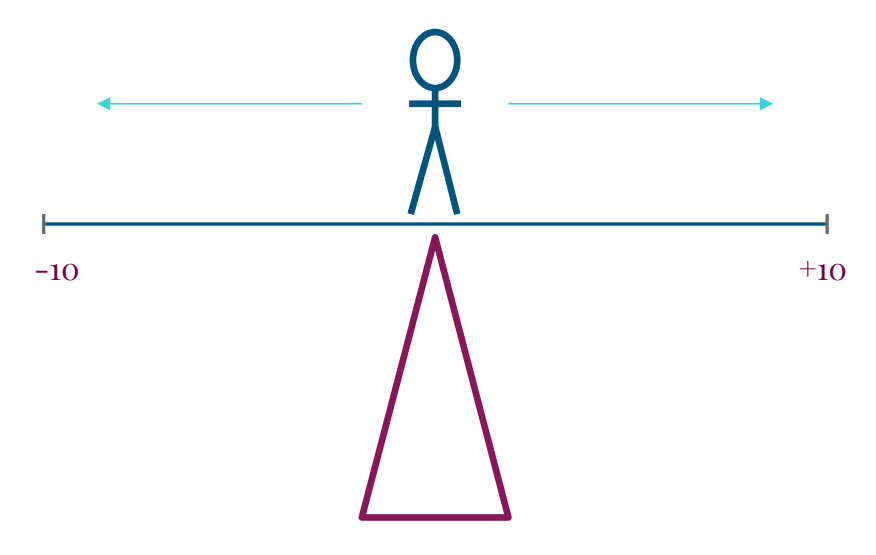
The Seesaw of Reaction
The Zero Zone Model can be visualised as a seesaw.
At the centre of the seesaw is zero or the pivot point. This is the Zero Zone, the place where you are balanced, grounded, calm, and able to respond consciously.
On either side of the seesaw are the reaction zones.
On the positive side (+10) sits the fight response, where we move into defensiveness, argument, control, or confrontation.
On the negative side (-10) sits the flight response, where we withdraw, avoid, shut down, or disengage.
Most people assume that reactions only happen at the extreme ends of the seesaw, but that isn’t the case. You don’t have to reach a +10 or a -10 to be triggered. Even a +2 or -3 means you have stepped off the centre. From the outside it may look like everything is perfectly calm. You might still be speaking politely and behaving professionally. But internally, something else has taken over.
What Happens in the Brain When We Are Triggered
When we perceive a threat, whether it is physical danger or social pressure, the limbic brain takes control. The limbic system is the part of the brain responsible for survival responses. Its job is to protect you quickly and automatically so when it activates, your body prepares to fight or flee. When this happens, blood moves away from the brain and digestive system and towards the extremities, your arms and legs, preparing you to run or defend yourself. This response was extremely useful when our ancestors were dealing with real physical threats. If a large animal was about to attack, you didn’t need to sit and problem solve the situation. You needed to move, FAST!
But in the modern workplace, the “threats” we encounter are very different.
Critical feedback.
A tense conversation.
A challenging deadline.
Feeling judged or misunderstood.
Our biology, however, has not changed. The body still reacts as if our life is in danger. Which means that even when we are only slightly triggered, we are literally operating with less thinking power. The frontal cortex, the part of the brain responsible for rational thought, perspective, and wise decision-making, becomes less available. And this is why conversations can escalate quickly. And why we sometimes say things we later wish we hadn’t.
The Power of the Zero Zone
The Zero Zone is the place where you can respond rather than react. Standing at zero does not mean you never feel triggered. Triggers are part of being human. However, the skill lies in recognising when you’ve stepped off centre and learning how to return. In high-pressure environments, the ability to return to zero is one of the most powerful skills a leader can develop.
So the next time you are triggered, do you stay there, or do you learn how to take a step back onto the pivot point, to a place where response, responsibility, and choice live.
The Zero Zone.
To find out more about The Indigo Brave Zero Zone Model or how Laila can help you and your business, get in touch today: laila@indigobrave.com